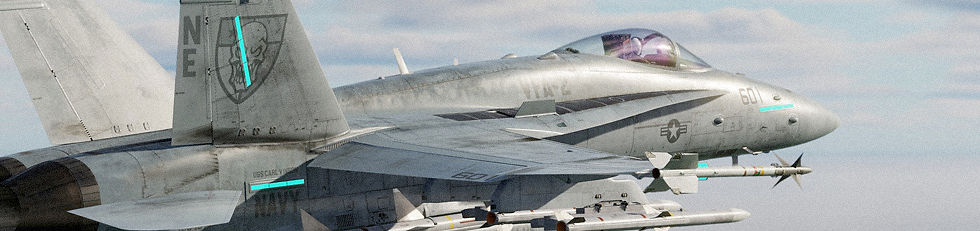
VFA-2 Bounty Hunters
Strike Fighter Squadron 2 (VFA-2), also known as the "Bounty Hunters," is a United States Navy F/A-18F Super Hornet strike fighter squadron based at Naval Air Station Lemoore, California. Their tail code is NE and their callsign is "Bullet." They are assigned to Carrier Air Wing 2 (CVW-2), a composite unit composed of a variety of aircraft performing a range of combat and support missions, deployed aboard the aircraft carrier Carl Vinson.
Four separate squadrons have held the VF-2 designation, but the U.S. Navy does not officially recognize a direct lineage between disestablished and newly formed squadrons, even if the new units adopt the nickname, insignia, and traditions of their predecessors. VF-2, also known as the "Bounty Hunters," was established on 14 October 1972 flying the F-14A Tomcat. The squadron completed its aircrew training and received its first aircraft in July 1973, reaching full operational strength by the spring of 1974. Its first deployment was later that year alongside VF-1 aboard USS Enterprise, including participation in Operation Frequent Wind over Saigon in April 1975. During their 1978 WestPac cruise, they made port calls in Pearl Harbor, Subic Bay, Singapore, Perth, and Hong Kong.
In the 1980s, VF-2 was assigned to USS Ranger during the Iran hostage crisis, spending significant time in the Indian Ocean and Persian Gulf. VF-2 was the first squadron to deploy the Tactical Air Reconnaissance Pod System (TARPS) for CVW-14 and later CVW-2. The squadron deployed aboard USS Kitty Hawk in 1984 and participated in "Team Spirit" exercises. During these, the carrier collided with the Soviet submarine K-314, causing damage to both vessels. Later that year, VF-2 made history by launching the first F-14 from a carrier while towing an air-to-air gunnery target. The squadron logged USS Ranger’s 260,000th landing and continued deploying with the carrier throughout the decade. In 1987, they took part in Operation Nimble Archer, retaliating against Iranian oil platforms during Persian Gulf tensions.
During the 1990s, VF-2 flew over 500 combat missions in Operation Desert Storm from USS Ranger, performing escort, reconnaissance, and combat air patrol duties. Afterward, they supported Operation Southern Watch and Operation Restore Hope in Somalia. When Ranger was decommissioned in 1993, VF-2 moved to USS Constellation and transitioned to the upgraded F-14D Tomcat. In 1996, their aircraft were modified to carry LANTIRN targeting pods, allowing precision strikes. In 1999, they struck SAM sites around Basra and intercepted two Iraqi MiG-23s, although no kills were recorded as the enemy aircraft turned back after detecting missile launches.
VF-2 continued to serve into the 2000s, deploying aboard Constellation in support of Southern Watch and later participating in Operation Iraqi Freedom during its final Tomcat cruise in 2002–2003. During this deployment, the squadron dropped nearly 300 bombs and delivered the first Tomcat JDAM in combat on 28 February 2003. On 1 July 2003, VF-2 was redesignated VFA-2 and began its transition to the F/A-18F Super Hornet, receiving its first jet in October of that year. In 2004, VFA-2 deployed with CVW-2 aboard USS Abraham Lincoln, participating in Operation Unified Assistance following the 2004 tsunami. Further deployments followed in 2006 and 2008.
In the 2010s, VFA-2 participated in exercises such as Foal Eagle 2006 alongside USAF elements from Kadena Air Base. In September 2010, the squadron again deployed with USS Abraham Lincoln to the Arabian Sea and Persian Gulf. By this time, the squadron had transitioned to Block II F/A-18Fs equipped with AESA radar, enhancing their air-to-air and strike capabilities.
As of the 2020s, the current commanding officer of VFA-2, Commander Timmester, holds the distinction of being the last active-duty Navy squadron commander to have flown the F-14 Tomcat. VFA-2 remains part of Carrier Air Wing 2 aboard the USS Carl Vinson. In November 2024, the squadron departed the U.S. on a scheduled deployment. After engaging in multiple exercises with Pacific Rim nations, they were redirected to the Red Sea to protect international shipping and support Israel in response to attacks from Houthi and Iranian proxy forces operating from Yemen. VFA-2 arrived in the CENTCOM area of responsibility in April 2025, beginning sustained combat operations against Houthi and Iranian targets shortly after arrival.
Our version of the VFA-2 US Navy Fighter Attack Squadron artwork, used in the F/A-18c Hornet livery:


ORIGINAL

REVISED
Please note: Featured on this site are many refreshed versions of the squadron's original emblem designs.
We've made subtle tweaks to some, more sweeping changes to others, but our intention is always to preserve the essence of the original ~ to create a slightly updated version that would print clearer on a variety of mediums.
All of our emblem design versions have been created with deep respect for the original design and their respective designers. It is our homage to these squadrons, their personnel, crews, and veterans.